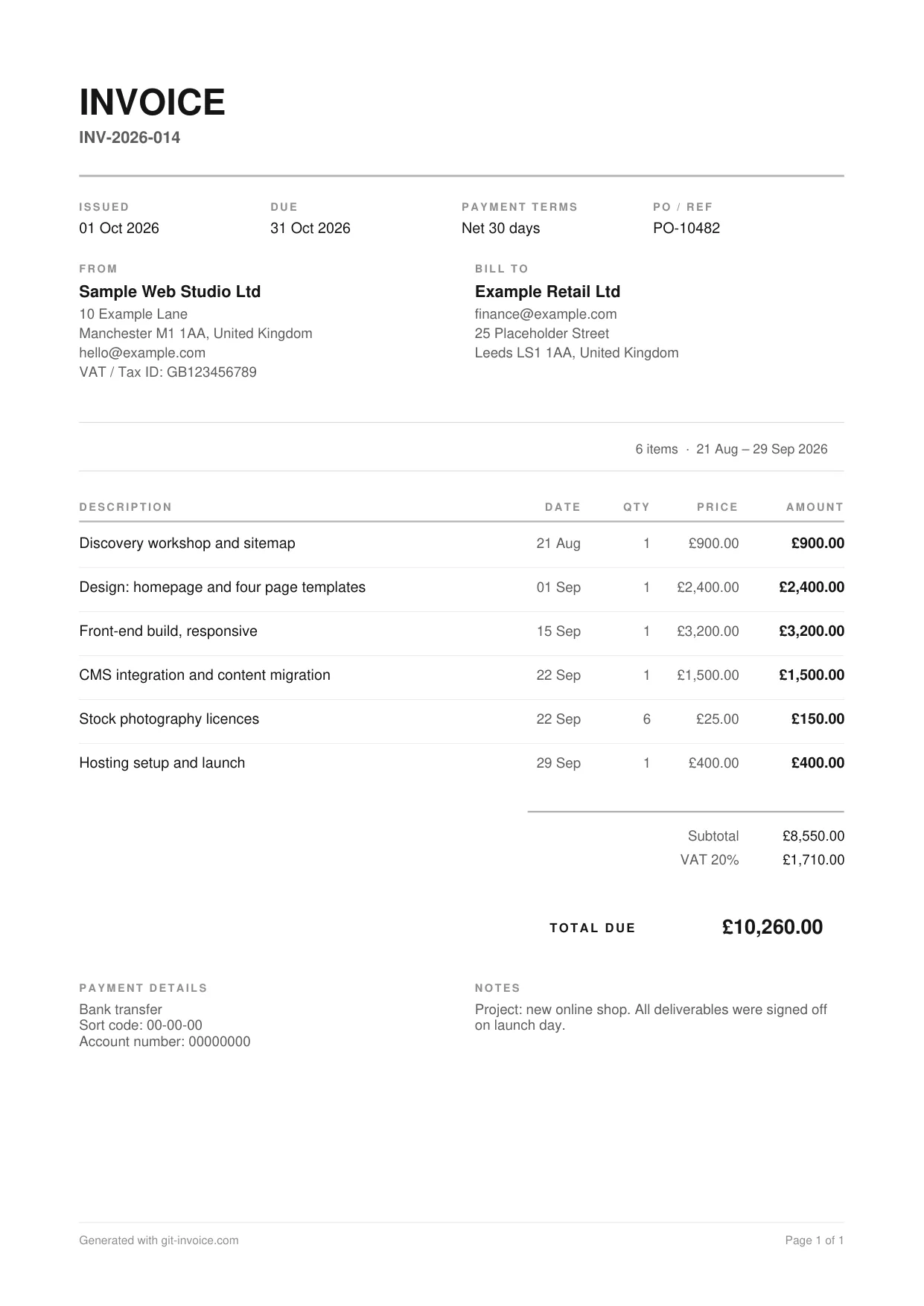
What is on this template
- Invoice number, issue date, due date, payment terms and PO reference
- Your company details with VAT number, and the client’s details
- One line per deliverable with date, quantity, unit price and amount
- Pass-through costs, such as licences, as separate lines
- Subtotal, VAT at 20% and the total due
- Bank details and a note naming the project
Deliverables instead of hours
A client who agreed to a price for a website wants to see the website on the invoice, not your timesheet. List what was delivered in the words the proposal used: discovery, design, build, content migration, launch. If the proposal had a price per phase, the invoice repeats those prices and the client can tick them off.
In the invoice generator, this is the “Quantity × price” mode. The columns read Qty and Price, and the subtotal no longer mentions hours.
How to fill it in
- Copy the phases and prices from your proposal or statement of work.
- Use quantity 1 for a phase, and real quantities for things you count, like licences.
- Date each line with the day the deliverable was accepted.
- Enter your VAT rate, or a tax note if you do not charge VAT.
- Add the client’s PO number, your bank details and the due date.
What a VAT invoice needs in the UK
The sample is set up for a VAT-registered studio in the United Kingdom. Every UK invoice must carry a unique identification number, your company name, address and contact information, the customer’s company name and address, a clear description of what you are charging for, the supply date, the invoice date, the amounts charged, the VAT amount if applicable and the total owed (GOV.UK: Invoices, what they must include).
A full VAT invoice adds your VAT registration number, the rate of VAT and the amounts excluding VAT, and it has to be issued within 30 days of the supply (HMRC VAT Notice 700/21). Outside the UK the details differ; the European Commission’s overview covers the EU.
After launch: retainers and renewals
Maintenance, hosting and support usually move to a monthly or yearly invoice once the project is live. Keep them off the project invoice. A separate recurring invoice with one or two lines is easier to approve than a project invoice that never quite ends. For support billed by time, use the hourly template.
Common mistakes
- One line reading “Website” with the full project price
- A deposit billed again on the final invoice
- Third-party costs hidden inside a deliverable
- VAT number missing on a VAT invoice
- No reference to the project or the purchase order
Other invoice templates
- Freelance developer invoice template: Hourly invoice whose lines point at pull requests and commits, with an EU reverse-charge note.
- Hourly invoice template: Time-and-materials invoice: one line per task with date, hours, rate and amount.
- Independent contractor invoice template: Monthly invoice for contract work with purchase order, contract reference and Net 30 terms.
Questions and answers
Should I invoice a web project by milestone or at the end?
By milestone, unless the project is small. A common split is a deposit before work starts, a payment when the design is approved and the balance at launch. It keeps your cash flow steady and gives the client natural points to sign off.
How do I invoice a deposit?
As its own invoice with one line, for example “Deposit, 40% of project fee”. When you send the final invoice, bill the remaining deliverables rather than the full project, so nothing is charged twice.
Should hosting, domains and licences be separate lines?
Yes. Costs you pass on, such as stock photos, fonts, plugins or hosting, are easier to approve when they are visible. The sample lists six photo licences as their own line with a quantity and a unit price.
What must a VAT invoice show in the United Kingdom?
According to HMRC’s VAT Notice 700/21: a sequential number that uniquely identifies the document, the time of supply, the date of issue, the supplier’s name, address and VAT registration number, the customer’s name and address, a description of the goods or services, and for each description the quantity, the rate of VAT and the amount payable excluding VAT, plus the total excluding VAT, the rate of any cash discount, the total VAT chargeable and the unit price.